Introduction
Percentages are everywhere. You encounter them when calculating a restaurant tip, understanding a sale discount, reading a nutrition label, interpreting a test score, or analyzing financial data. Despite being one of the most commonly used mathematical concepts, many people feel uncertain about percentage calculations.
This guide will demystify percentages with clear explanations, practical formulas, and real-world examples that make the concept immediately useful in daily life.
What Is a Percentage?
A percentage is a way of expressing a number as a fraction of 100. The word "percent" comes from the Latin "per centum," meaning "per hundred." The symbol % represents "divided by 100" or "out of 100."
So 45% means 45 out of 100, or 45/100, or 0.45 as a decimal.
The Three Core Percentage Calculations
1. Finding a Percentage of a Number
Formula: (Percentage / 100) × Number
Example: What is 20% of $85?
(20 / 100) × 85 = 0.20 × 85 = $17
Use case: Calculating a 20% tip on a restaurant bill.
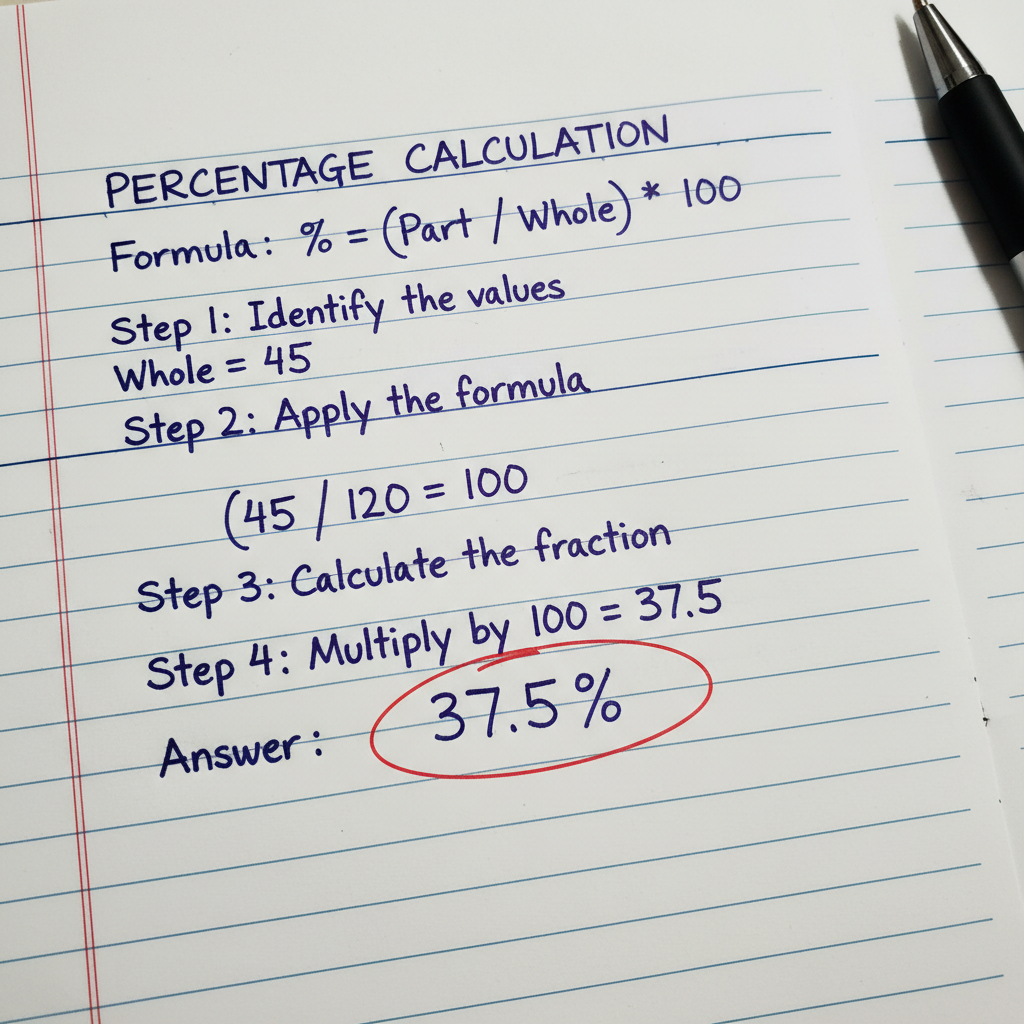
2. Finding What Percentage One Number Is of Another
Formula: (Part / Whole) × 100
Example: You scored 42 out of 50 on a test. What percentage did you get?
(42 / 50) × 100 = 84%
Use case: Converting test scores to percentages.
3. Finding the Original Number from a Percentage
Formula: Part / (Percentage / 100)
Example: 30 is 60% of what number?
30 / (60 / 100) = 30 / 0.60 = 50
Use case: Working backward from a discounted price to find the original price.
Percentage Increase and Decrease
Percentage Increase
Formula: ((New Value − Old Value) / Old Value) × 100
Example: A product's price rose from $40 to $52. What is the percentage increase?
((52 − 40) / 40) × 100 = (12 / 40) × 100 = 30%
Percentage Decrease
Formula: ((Old Value − New Value) / Old Value) × 100
Example: A salary was reduced from $60,000 to $54,000. What is the percentage decrease?
((60,000 − 54,000) / 60,000) × 100 = (6,000 / 60,000) × 100 = 10%
Practical Everyday Applications
Shopping Discounts
A jacket is $120 with a 35% discount. How much do you pay?
Discount = 0.35 × $120 = $42
Final price = $120 − $42 = $78
Sales Tax
A laptop costs $800 before 8.5% sales tax. What's the total?
Tax = 0.085 × $800 = $68
Total = $800 + $68 = $868
Tip Calculation
Quick tip calculation: Move the decimal one place left to find 10%, then multiply.
$67 bill, 20% tip: 10% = $6.70 → 20% = $13.40
Interest Rates
A savings account offers 4.5% annual interest on $2,000.
Annual interest = 0.045 × $2,000 = $90
Common Percentage Mistakes
- Confusing percentage points with percentages: A rate rising from 2% to 3% is a 1 percentage point increase, but a 50% relative increase
- Reversing the formula: "X% of Y" is different from "Y% of X" (though both equal the same number when X and Y are swapped)
- Stacking discounts incorrectly: Two 10% discounts do not equal a 20% discount — they equal 19% (0.9 × 0.9 = 0.81)
Mental Math Shortcuts
- 10%: Move decimal one place left ($350 → $35)
- 5%: Half of 10% ($350 → $17.50)
- 25%: Divide by 4 ($200 → $50)
- 50%: Divide by 2 ($180 → $90)
- 1%: Move decimal two places left ($450 → $4.50)
FAQ
What does "percentage points" mean?
Percentage points refer to the arithmetic difference between two percentages. If unemployment rises from 4% to 6%, it increased by 2 percentage points (not 2%).
How do I convert a decimal to a percentage?
Multiply by 100. So 0.75 = 75%, 0.03 = 3%, 1.25 = 125%.
Can a percentage be over 100%?
Yes. If something doubles, it increases by 100%. If it triples, it increases by 200%. A 150% increase means the new value is 2.5 times the original.
How do I calculate compound percentage growth?
For compound growth, multiply by (1 + rate) for each period. For example, 10% growth for 3 years: 1.10 × 1.10 × 1.10 = 1.331, or 33.1% total growth.
What is the difference between percentage and percentile?
A percentage is a proportion out of 100. A percentile indicates the value below which a given percentage of observations fall. Scoring in the 90th percentile means you scored higher than 90% of test-takers.
Related Calculators
Conclusion
Percentages are a fundamental mathematical tool that appear in virtually every area of life. Once you master the three core formulas and a few mental math shortcuts, you'll be able to quickly calculate discounts, tips, interest rates, and statistical data with confidence. Practice with real-world scenarios and use our Percentage Calculator to verify your work as you build fluency.